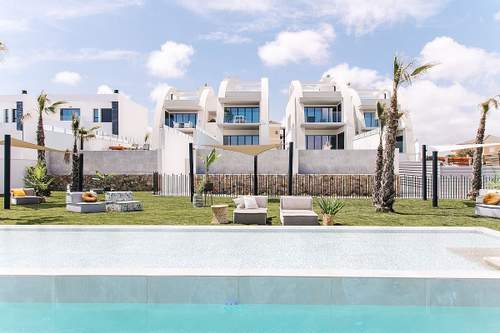

Torrevieja Property 2026: Who Buys, Who Rents, Who Leaves
 Wesna Group
136 listings, an entry price of EUR 129,900 and a town that trades in January as well as July. What Torrevieja gets right, what it really costs to run, and why so many foreign owners sell within five years.
Torrevieja is the largest single market on our books: 136 properties for sale, against 77 in Pilar de la Horadada and 44 in Orihuela Costa. The cheapest is a 2-bed apartment at EUR 129,900. That entry price is the lowest of any coastal town we cover, and it explains most of what this town gets right and most of what it gets wrong.
Three groups define the place: people who buy, people who rent, and people who leave. The last group is the part the brochures skip.
Two salt lakes, 15 km of coast and no railway station
Torrevieja sits at the bottom of Alicante province, in the Vega Baja del Segura, roughly 45 km south of Alicante and 50 km east of Murcia city. The padrón has been climbing through the 90,000s, and close to half of everyone registered holds a passport that is not Spanish. Check that ratio against the municipal population series published by INE rather than any agency brochure.
The town grew on salt, not tourism. Two lagoons sit immediately inland, protected together as a parque natural under the Generalitat Valenciana: Laguna de La Mata to the north and the larger Laguna de Torrevieja behind the town. The Torrevieja lagoon is a working salt works, one of Europe's biggest producers, and it runs pink, from Dunaliella salina algae, salt-loving bacteria and the Artemia brine shrimp that also turn the flamingos pink. You cannot swim in it, and the ayuntamiento fines people who wade in for the photograph.
Every agent here repeats that the World Health Organization named Torrevieja one of the healthiest places on earth in the 1980s. Nobody produces the document. What is measurable is low rainfall, moderate humidity, and decades of people with respiratory complaints saying they feel better here. The rest is folklore that has been very good for property prices.
Torrevieja holds roughly 15 km of coast. Playa del Cura is the central urban beach, imported sand below the promenade, backed by the town rather than by an urbanisation, and Blue Flag in most recent seasons. You can walk to it from a flat in the centre with a towel and no car, which matters more than it sounds. Playa de los Locos, just north, is longer, shallower and the family default in July. South run Playa de los Náufragos and rocky coves towards Cala Ferrís, for adults who swim rather than anyone with a pushchair.
La Mata, at the north end, is the quieter half. Torrelamata was a separate village and still behaves like one: lower buildings, a long dune-backed beach on the edge of the natural park, more Spanish families, fewer laminated menus. Prices run above the inland urbanisations and below the central front line, and it is where most buyers land when the density puts them off.
Hospital Universitario de Torrevieja opened in 2006 and ran under a public-private concession until the Generalitat Valenciana took it back into direct management in October 2021. It covers Torrevieja and a dozen surrounding municipalities, with several centros de salud and private clinics in the town. A general hospital inside the municipality puts Torrevieja ahead of almost every town on the northern Costa Blanca for anyone buying at sixty and planning to be here at eighty. Complex specialist work still routes to Alicante.
Transport is the weak side. There is no railway station and there never has been. Alicante-Elche airport is about 45 km away, 35 to 45 minutes on the AP-7, toll-free on this stretch since the concession expired at the end of 2019. Murcia airport is roughly 65 km. Coaches run to both airports and to Alicante, Cartagena and Murcia, but you need a car, and in the outer urbanisations two.
Who buys in Torrevieja
248 homes in Torrevieja from €90,000
See all 248

The British group is the oldest and one of the largest, going back to the 1980s, concentrated in the inland urbanisations built through the 1990s and 2000s: La Siesta, El Chaparral, Torreta, Aguas Nuevas, San Luis. Brexit reshaped that demand rather than killing it. The 90-days-in-any-180 Schengen limit pushed second-home buyers into a smaller purchase or a full residency application, and it made the tax treatment of rental income materially worse.
Swedes are the strongest Nordic group here; Norwegians cluster further north around Alfaz del Pi and Albir. German and Belgian buyers favour the newer gated developments and the La Mata side, and Dutch buyers land more often a few kilometres south in Orihuela Costa and Ciudad Quesada. Bulgarian, Romanian, Polish, Moroccan and Latin American residents make up much of the working population, and much of why the long-let market functions all year.
The Golden Visa was abolished by Ley Orgánica 1/2025 with effect from 3 April 2025. Buying in Torrevieja buys you property and nothing else. The live routes in 2026 are the Non-Lucrative Visa, the Digital Nomad Visa and the Beckham regime.
What each budget actually buys
The bands below are asking prices we track across the main portals in mid-2026, not registered sale prices. Notary-recorded figures usually land 5% to 12% below asking, wider on anything listed for a year.
| Budget | What it buys | Typical size | Where |
|---|---|---|---|
| Under EUR 120,000 | 1-bed or small 2-bed resale, 1970s-1990s block, often no lift | 40 to 60 m2 | Inland urbanisations, older central blocks |
| EUR 120,000 to 180,000 | 2-bed resale apartment with a communal pool | 55 to 75 m2 | La Siesta, El Chaparral, Torreta, Aguas Nuevas |
| EUR 180,000 to 260,000 | 2-bed near the beach, or a 2000s bungalow with solarium | 60 to 85 m2 | La Mata, streets behind Los Locos, Los Balcones |
| EUR 260,000 to 400,000 | New or near-new 2 or 3-bed with lift, garage and gated pool | 65 to 100 m2 | Nueva Torrevieja, Los Balcones, Punta Prima side |
| EUR 400,000 to 600,000 | Front-line apartment with sea view, or a modern semi-detached with a plot | 80 to 130 m2 | Playa del Cura promenade, La Mata front, La Veleta |
| EUR 600,000 upward | Detached villa, private pool, 400 to 800 m2 plot | 110 to 200 m2 | Los Balcones, Los Altos, La Siesta villa streets |
Three of our own listings show the spread. WES-18039-rev, a 2-bed apartment of 59 m2 at EUR 129,900 works out at about EUR 2,200 per m2 and is the cheapest thing we hold in the town. WES-2031E, a 2-bed of 69 m2 at EUR 327,000 is roughly EUR 4,700 per m2, and that gap is age, finish and location rather than size. WES-2329, a 3-bed house of 120 m2 at EUR 725,000 in Los Balcones sits at the ceiling of our entire house range, where per-m2 arithmetic means little because you are buying the plot and the pool.
What barely exists is a middle of well-built, well-insulated, walk-to-the-beach stock at EUR 200,000, which is exactly what most buyers arrive looking for.
How Torrevieja prices against the four towns next door
| Town | Our sale listings | Our entry price today | Typical asking EUR per m2 | The trade against Torrevieja |
|---|---|---|---|---|
| Torrevieja | 136 | EUR 129,900 | 1,500 to 4,600 | Everything open in January, crowds in August |
| Orihuela Costa | 44 | EUR 147,500 | 2,200 to 4,000 | Newer stock, better-run urbanisations, thinner winter |
| Pilar de la Horadada | 77 | EUR 245,000 | 2,300 to 3,800 | Working Spanish town, calmer, less English spoken |
| Guardamar del Segura | 28 | EUR 222,000 | 2,100 to 3,400 | Pine forest and dunes, low-rise by law, less choice |
| Los Alcázares | 73 | EUR 265,000 | 2,200 to 3,600 | Mar Menor and golf, but check the flood history |
Orihuela Costa is the closest substitute and the one our Torrevieja buyers most often choose: stock fifteen to twenty years younger, better-designed urbanisations, emptier winter, more driving. Pilar de la Horadada is our second-largest market at 77 listings, a working Spanish town with a beach annexe at Torre de la Horadada. Guardamar has the best natural setting of the five, but heights are capped and we hold only 28 listings. On Los Alcázares and the Mar Menor, the DANA floods of 2016 and 2019 are a due-diligence item on any ground-floor property.
Who rents, and what the yield actually is
Most Spanish coastal towns run on a twelve-week season. Torrevieja does not, and that single fact is the investment argument. A large retired Northern European population lives here permanently, invernantes arrive in October and leave in April, the IMSERSO subsidised senior programme fills hotel beds through winter, and a local working population needs housing every month and mostly cannot afford to buy.
A decently presented 2-bed therefore lets on a long contract in February about as easily as in June. Gross long-let rents in mid-2026 run roughly EUR 650 to EUR 850 a month for an older 2-bed inland, EUR 800 to EUR 1,000 for something modern or near the beach, and EUR 1,100 to EUR 1,600 for a 3-bed villa with a pool. Our survey of long-term rental yields on the Costa Blanca sets Torrevieja against the rest of the coast.
Gross against net, on a real listing
Take the cheapest thing we hold.
| Line | EUR |
|---|---|
| Purchase price (WES-18039-rev, 59 m2) | 129,900 |
| Purchase costs at roughly 13% | 16,900 |
| Furnishing to long-let standard | 7,000 |
| Total capital in | 153,800 |
| Gross annual rent at EUR 750 a month | 9,000 |
| Gross yield on purchase price alone | 6.9% |
| Gross yield on total capital in | 5.9% |
| Community fee, IBI, refuse, insurance | -1,370 |
| Management at 9%, maintenance, one averaged void month | -2,060 |
| Net operating income, before tax | 5,570 |
| Net yield on total capital in, before tax | 3.6% |
Two numbers do the work. The 6.9% headline is what most listings quote: gross, on the price alone, before a cent of cost. The 3.6% is net, what reaches the account before the tax authority takes its share, assuming a tenant who pays.
The tax layer splits by passport. Residents of the EU and EEA pay 19% on net rental profit and can deduct running costs, roughly EUR 1,060 on the example above, leaving about 2.9% net after tax. Everyone else, including British owners since Brexit, pays 24% on gross rent with no deductions: EUR 2,160 on the same flat, dropping the return to roughly 2.2% net. Modelo 210 on rental income is filed annually, each January, not quarterly.
Tourist licences, and what you must not assume
Short-let numbers look better on paper and the path to them has narrowed. A vivienda de uso turístico in the Comunitat Valenciana needs a municipal urban-compatibility report and registration with the regional tourism register before it can be advertised. Torrevieja has not shut the door the way Valencia city has, but the process is slower.
The bigger constraint sits inside the building. Since Ley Orgánica 1/2025 took effect in April 2025, a community of owners can block new tourist letting by a three-fifths majority, and in Torrevieja's residential blocks, where most owners are retired people who live there, those votes tend to pass. Never assume you can add a licence to a flat that lacks one. If a listing claims one, get the registration number and verify it before the arras. Our guide to where you can still get a vacation rental licence covers the regional position.
What a Torrevieja property costs to run
Annual figures in euros, before repairs or special levies.
| Cost line | 2-bed, older inland block | 2-bed, gated 2020s complex | 3-bed villa with pool |
|---|---|---|---|
| IBI | 190 to 330 | 280 to 480 | 450 to 900 |
| Refuse collection | 60 to 120 | 60 to 120 | 90 to 160 |
| Community fee | 300 to 650 | 900 to 1,800 | 0 to 900 |
| Electricity | 700 to 1,100 | 750 to 1,200 | 1,400 to 2,600 |
| Water | 260 to 420 | 260 to 420 | 550 to 1,100 |
| Buildings and contents insurance | 180 to 300 | 200 to 340 | 380 to 700 |
| Pool and garden | in the community fee | in the community fee | 1,400 to 3,000 |
| Total before repairs | 1,690 to 2,920 | 2,450 to 4,360 | 4,270 to 9,360 |
IBI follows the valor catastral held in Catastro records, not what you paid, so two identical flats in one block can differ. Ask for last year's receipt at the viewing; the seller has it in a drawer. Our breakdown of how IBI is calculated in 2026 explains why the bill looks arbitrary.
Non-resident owners owe imputed income tax on top, let or not, calculated on 1.1% or 2% of the valor catastral and charged at 19% for EU and EEA residents or 24% for everyone else. That filing is annual too.
The community fee is the line that moves, and the one buyers underestimate. A 1980s block with no lift and no pool can run EUR 25 a month; a modern gated complex with three pools, gardens, underground parking, two lifts and a concierge runs EUR 150 or more. Ask for the last two annual accounts and the minutes of the last two general meetings before you sign. Read them for arrears, because absentee owners who stop paying leave the solvent ones covering the shortfall, and for any pending derrama on lifts, façade work or pool relining.
Who leaves, and why
Torrevieja has an unusually high turnover of foreign owners, and pretending otherwise helps nobody. Roughly speaking, the people who sell within five years bought in July, and the people who are still here at twenty bought in February.
The most common seller we deal with is not a disappointed buyer at all. It is a couple in their late seventies moving out of a villa into a lift-served flat near the centre, or going home to be near their children. A detached house on a 600 m2 plot in an outer urbanisation is a fine place to be sixty-five and a difficult place to be eighty-two. Once you stop driving, a property with one bus an hour, no pavement to the shop and a pool that still needs maintaining becomes a trap rather than a home. Add stairs, add a partner who needs a hospital appointment twice a month, and the arithmetic changes fast. It is also why so much of the resale stock in the outer estates dates from the same fifteen-year window and comes to market in the same condition.
August and January are two different towns
In August the resident population multiplies several times over. The N-332 through town becomes a car park, parking near Playa del Cura is a competitive sport by nine in the morning, restaurant waits run to an hour, and the noise in the central blocks continues past two in the morning because that is when Spain eats. Some owners love it. A meaningful minority stop coming in August and let the flat instead.
January is the mirror image, and it depends entirely on where you bought. The centre stays open: the shops on Ramón Gallud trade, the market runs, the hospital and the Habaneras shopping centre function, and there is a real year-round town underneath the tourism. That genuinely distinguishes Torrevieja from Moraira or Benissa further north, which shut. The outer urbanisations are a different story. Parts of El Chaparral, La Siesta and the older estates run well under half occupied through winter. The urbanisation bar closes, the community pool is emptied and netted, your neighbours on both sides are shuttered, and the nearest open supermarket is a drive. People who bought a villa 6 km out because it was quiet discover in their second winter that quiet and empty are not the same word.
Selling into a sea of near-identical flats
Torrevieja's oversupply is real. Hundreds of 2-bed apartments of 55 to 75 m2, built between 1998 and 2008, in urbanisations that look alike, sit on the market at any given time. If yours has nothing to distinguish it, price is the only lever you hold, and buyers know it.
A generic 2-bed in an inland urbanisation takes six to twelve months to sell and completes 8% to 15% below its first asking price. A front-line apartment with a genuine sea view, a well-run modern complex or a villa with a good plot moves in weeks at close to asking. The difference is not the town. It is whether the property is one of many or one of few.
Two structural issues sit underneath the slow end of that market. Anything licensed before the 2006 Código Técnico de la Edificación was built with minimal insulation, and most Torrevieja stock from the boom years is exactly that: thin walls, thermal bridges, basic glazing, energy certificates in the E to G range. It is comfortable for eight months and expensive to cool for two. Air conditioning run hard through July and August can add EUR 100 to EUR 180 a month to a bill that sits near EUR 60 the rest of the year. Retrofitting decent glazing and a modern inverter unit costs EUR 6,000 to EUR 12,000 on a small flat; buyers will not pay that back in full, but it moves you out of the undifferentiated pile.
The other issue is the ageing blocks themselves. Buildings from the 1970s and early 1980s are reaching the point where lifts need replacing, façades need work and the Comunitat Valenciana's building evaluation regime applies. Those bills arrive as derramas, split between owners, and EUR 1,500 to EUR 4,000 landing on a flat worth EUR 110,000 is what tips some owners into selling.
Selling costs are worth knowing in advance. Agency commission runs 3% to 5% plus IVA, the seller pays plusvalía municipal, and a non-resident seller has 3% of the sale price withheld at completion against capital gains tax, reclaimable if the actual gain is smaller. Capital gains runs at 19% for EU and EEA residents and 24% for everyone else.
Frequently asked questions
Is Torrevieja too crowded to live in year-round?
The centre is not, and that is the surprise. Torrevieja has a genuine year-round town underneath the summer: shops, a market, a hospital and restaurants that open in January, which most Costa Blanca resorts lack. August is intense and there is no way around it. If crowding worries you, buy in La Mata rather than near Playa del Cura.
What can I actually buy in Torrevieja for EUR 150,000?
A 2-bed resale apartment of roughly 55 to 75 m2 in an inland urbanisation, usually with a communal pool, built between the late 1990s and 2008, and usually needing a kitchen and bathroom refresh. The cheapest property on our books today is a 2-bed of 59 m2 at EUR 129,900. Add roughly 13% for purchase costs on top of any agreed price.
Can I get a tourist licence for a Torrevieja apartment?
Sometimes, and you should not buy on the assumption. A licence needs a municipal compatibility report and regional registration, and since Ley Orgánica 1/2025 took effect in April 2025 a community of owners can block new tourist letting by a three-fifths majority. In blocks full of permanent retired residents, those votes often pass.
Is Torrevieja or Orihuela Costa the better buy?
Torrevieja if you want a functioning town in winter, the lowest entry price on this coast and the widest choice: 136 of our listings against 44 in Orihuela Costa. Orihuela Costa if you want newer, better-planned stock and accept a quieter winter and more driving. For twelve-month rental reliability, Torrevieja wins clearly.
How long does it take to sell a Torrevieja apartment?
A generic 2-bed in an inland urbanisation typically takes six to twelve months and completes 8% to 15% under first asking, because you compete with hundreds of near-identical flats. Front-line apartments, well-run modern complexes and villas with real plots sell in weeks near asking. Buy something with a distinguishing feature.
Next steps
Open our 136 Torrevieja listings, pick the two or three that fit your budget and send us the references. We will give you the community fee, the energy letter and the realistic sale time on each.
Get our Costa Blanca property guides
One short email a month with new neighborhood guides, market notes, and rule changes. No spam, unsubscribe in one click.
We use your email only for the newsletter. Read our privacy policy for details.