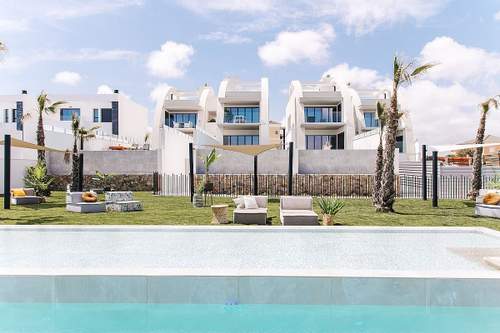

Rojales and Quesada 2026: Same Area, Different Buyers
 Wesna Group
Ciudad Quesada carries 31 live listings, old Rojales carries 6. Same municipality, two completely different markets, and the gap between them explains most of what a buyer needs to know about the Vega Baja in 2026.
Ciudad Quesada carries 31 live listings on our books in October 2026, old Rojales carries 6. Both postcodes sit inside the same ayuntamiento, five minutes apart by car, yet the price per square metre, the buyer profile and the day-to-day routine are not comparable. If you have been shown both as one area, you have been shown half the picture.

This guide splits the two markets. Who buys what, what you pay in 2026, where the Dutch, British, Belgian and Scandinavian clusters actually sit, and the running costs that turn a cheap-on-paper purchase into a reasonable monthly bill. We hold decent stock in Quesada and limited stock in the old town, and we say so when a search throws up more of the latter.
Are Rojales and Ciudad Quesada the same place?
No. Rojales is a Spanish river town of roughly 20,000 registered residents on the Segura, with a 17th-century bridge, a weekly market and a working high street in Castilian. Ciudad Quesada is a planned urbanization that climbs the hill behind it, launched in the 1970s by a developer who sold plots to Northern Europeans and never really stopped. Administratively they share one ayuntamiento. Culturally they are two towns.
The practical consequence is simple. In old Rojales you buy a Spanish townhouse on a Spanish street and your neighbours speak Spanish. In Quesada you buy a bungalow or villa on a numbered calle inside an urbanization and your neighbours are more likely to be Dutch, Belgian, British or Norwegian than Spanish. Both have their logic.
Why the single-municipality framing confuses buyers
Portals aggregate listings by ayuntamiento. Search "Rojales" on Idealista and most of what returns is Quesada stock, because that is where the volume sits. If you came to a viewing expecting the river and got a cul-de-sac of pastel bungalows, this is why. Our own Ciudad Quesada property guide for 2026 treats the urbanization as its own market, which is how buyers actually experience it.
Who actually buys in Rojales and Quesada?
Quesada draws retirees and semi-retired couples from Northern Europe, with a visible Dutch and Belgian core, a long-established British community and a growing Scandinavian presence. The typical purchase is a two or three-bedroom bungalow or detached villa between EUR 220,000 and EUR 450,000, with a private or communal pool, used eight to ten months a year or lived in full-time by residents on a Non-Lucrative Visa or Digital Nomad Visa.
Old Rojales attracts a different profile. Local Spanish owners dominate, with a smaller foreign segment made up of long-stay residents who want a workable budget, walking access to shops and bars that are open all year, and a lower comunidad bill. Prices are lower, properties are often older, and the renovation element is real. Younger couples who want to be inside a Spanish community rather than beside one tend to end up here.

Across our 2026 enquiries, roughly four in five Rojales-area buyers were looking at Quesada product, one in five at old-town or river-side property. Within the Quesada group, Dutch and Belgian enquiries led on the central and lake sub-areas, British enquiries skewed to Doña Pepa and Lo Marabú, Norwegian and Swedish buyers were spread but concentrated near the La Marquesa golf course. The Spanish buyer in Quesada is a minority; in old Rojales they are the majority.
Dutch and Belgian buyers
The single largest foreign community in Quesada, with Dutch and Flemish-Belgian owners concentrated in Doña Pepa and the central sub-area. The service economy reflects it: Dutch supermarkets, bakeries, a Dutch church service, Dutch-language dentists and lawyers. For a Dutch or Belgian buyer, Quesada removes the language-barrier friction almost completely for the first year or two, which is why it keeps winning that enquiry.
British buyers
The oldest foreign community in the area, present since the first developer phases. British buyers today spread across Doña Pepa, Lo Marabú and La Marquesa, with a slight preference for freestanding villas with private pools over the bungalow format. Since Brexit the typical British purchase splits into retirees applying for the Non-Lucrative Visa and seasonal owners staying within the 90-in-180 rule. The Brexit 90-180 rule guide is the current reference.
Scandinavian buyers
Norwegian and Swedish buyers in Quesada are a growing minority rather than a dominant cluster, more scattered through the urbanization than the Dutch core. The strongest Scandinavian presence on the Costa Blanca is further north around Alfaz del Pi and Albir, but Quesada attracts the Scandinavian buyer who wants warmer winters and a lower price point than the Alfaz area.
Spanish buyers in Rojales
Spanish buyers are the majority in the old town and a minority in Quesada. Those who do buy in the urbanization tend to be professionals from Madrid or the interior looking for a second home, or local families from Rojales and Torrevieja upgrading to a villa. In the old town the buyer is more often a working family or a returning emigrant with ties to the Segura valley, which keeps the demographic balance tilted toward Castilian speakers.
What do Rojales and Quesada property prices look like in 2026?
Prices rose across the Vega Baja through 2024 and 2025 and settled into single-digit growth through 2026, broadly in line with the national pattern the INE has been publishing quarterly. The headline on the ground: a two-bedroom apartment in Quesada starts around EUR 150,000 for older resale and moves above EUR 300,000 for new-build in the better urbanizations. Villas with a private pool run from the low EUR 400s to over EUR 700,000 on larger plots.
| Property type | Sub-area | Typical 2026 price | Typical size |
|---|---|---|---|
| 2-bed apartment, resale | Quesada centre | EUR 150,000 to EUR 190,000 | 65 to 80 m2 |
| 2-bed apartment, new-build | Doña Pepa / lake side | EUR 260,000 to EUR 330,000 | 75 to 95 m2 |
| 3-bed bungalow, resale | Quesada central | EUR 220,000 to EUR 290,000 | 85 to 110 m2 |
| 3-bed bungalow, new-build | Doña Pepa / Lo Marabú | EUR 320,000 to EUR 420,000 | 95 to 125 m2 |
| 3-bed detached villa, resale | Quesada hillside | EUR 350,000 to EUR 500,000 | 120 to 160 m2 on 300 to 500 m2 plot |
| 3-bed detached villa, new-build | Lo Marabú / La Marquesa | EUR 480,000 to EUR 700,000+ | 130 to 180 m2 on 350 to 600 m2 plot |
| Townhouse, resale | Old Rojales | EUR 95,000 to EUR 170,000 | 90 to 140 m2, often needing work |
| Village house with patio | Old Rojales | EUR 140,000 to EUR 220,000 | 120 to 180 m2 |
Two caveats before you plan a budget around that table. First, new-build sold off-plan comes with 10 percent IVA and 1.5 percent AJD in the Valencian Community, not the 10 percent ITP that applies to resale, and the delivery window on Vega Baja projects running in 2026 is typically 14 to 20 months from reservation. Second, villa prices move most on plot size and pool type, not on built square metres. A smaller villa on a 600 m2 plot often prices higher than a bigger one on a 300 m2 plot in the same calle.
What we currently carry
Our live Quesada sample includes WES-2048B, a 2-bedroom 81 m2 apartment in Doña Pepa at EUR 313,000; WES-2048E, a 3-bedroom 106 m2 apartment in the same complex at EUR 415,000; and WES-2187C, a 3-bedroom 123 m2 villa in Lo Marabú at EUR 649,000. The full set sits in the Ciudad Quesada catalog. The Rojales catalog is thinner, with six active listings in October 2026, mostly 2 and 3-bedroom product in the EUR 200,000 to EUR 450,000 band around the Las Heredades side. If you want wider old-town stock, treat it as an alert-based search rather than an off-the-shelf category.

Which sub-areas work best?
Quesada splits into recognisable zones. Each has a different noise level, a different age mix, and a different distance to the two things most buyers want: the beach and a supermarket.
Doña Pepa
The largest and best-known sub-area, Doña Pepa sits on the lake side of Quesada and holds most of the newer bungalow and villa product. The streets are quieter than central Quesada, the comunidades tend to be well-run, and the view across the salt lakes to the Mediterranean is the thing people buy. Downsides are honest: parking tightens in July and August, and the main avenue carries traffic noise if you buy on it.
Lo Marabú and Lo Pepín
Newer villa clusters on the hillside above Quesada, these two have become the premium sub-areas for buyers who want a private pool and a real plot. Prices run higher per square metre, build quality on 2022 to 2026 deliveries is generally good, and distances to the Consum and Mercadona are a 3 to 5 minute drive. If you want to walk to a restaurant without taking the car, these are not the right postcodes.
Central Quesada and La Marquesa
The older heart of the urbanization, around the commercial centre and the La Marquesa golf course. Resale apartments and older bungalows dominate, prices per metre are the lowest in Quesada, and you can genuinely live without a car for day-to-day. The trade-off is that the housing stock is generally 1990s to early 2000s, with the plumbing and electrics that implies, and the comunidad fees on some blocks are climbing to fund pool and lift renovations.
Las Heredades and the river side
The cluster closest to old Rojales and the Segura, with lower density and a more Spanish feel. Our listing WES-2159 sits here as a 3-bedroom 168 m2 house at EUR 439,000, which gives a sense of the price point. Buyers who want some green between neighbours but still inside the Rojales postcode often land here.
Old Rojales itself
The town centre, the bridge, the market square. Townhouses and village houses, mostly needing light or heavy renovation, with the lowest entry prices in the municipality. The right buyer here is someone who speaks or will learn functional Spanish, who wants Spain rather than a Spanish holiday backdrop, and who can either do or project-manage renovation work. Our Spain renovation cost per m2 guide for 2026 is the honest reference for budgeting that part.

Which sub-area suits which buyer?
A rough matching exercise, based on the briefs we actually close.
Retired couple from the Netherlands or Belgium, EUR 300,000 to EUR 400,000, lock-and-leave eight months a year. Doña Pepa 3-bedroom bungalow with communal pool. Walking distance to the Dutch supermarket, 10 to 15 minutes to Guardamar beach, service economy already speaks your language.
British semi-retired couple on the Non-Lucrative Visa, EUR 450,000 to EUR 650,000, full-time living. Lo Marabú or Lo Pepín detached villa with private pool. Three bedrooms, 350 to 500 m2 plot, car-dependent but calm, English-speaking GP in the urbanization.
Younger Spanish-speaking couple, EUR 150,000 to EUR 220,000, want integration not insulation. Old Rojales townhouse with patio. Budget for renovation on top. Spanish neighbours, Spanish school for the children, Spanish bars that are open on a wet Tuesday in February.
Investor targeting long-let yield rather than holiday rental. Quesada 2-bedroom apartment in the EUR 150,000 to EUR 190,000 band, central sub-area. The Vega Baja long-let market is thin but real, particularly to Northern European long-stay tenants on 3 to 6-month winter contracts.
Holiday-let investor. Short-term tourist licences in the Valencian Community are restricted, with new licence issuance tightened across the region in 2025 and 2026. The vacation rental licence 2026 guide spells out where you can and cannot still get one. Buying in Quesada specifically to run a Booking.com flat is harder than it was five years ago.
Against the two obvious alternatives further south, Torrevieja offers more apartment stock at lower price points, walking access to a real beach and denser services. Orihuela Costa offers a wider range of golf-adjacent villa product and more newer-build stock, but is more car-dependent and more fragmented across its sub-urbanizations. Quesada sits between them on density and above both on established Dutch-Belgian service economy. For the direct match-up, read our Torrevieja vs Orihuela Costa 2026 piece; for apartment-specific context, the Torrevieja two-bedroom apartments guide and the Los Balcones Torrevieja piece are the right side-by-side reads.
What is daily life like in the Vega Baja?
Quesada residents live inside a Northern European service economy that happens to be in Spain. Supermarkets, bakeries, hairdressers, dentists, bars and restaurants are either multilingual or run by foreign owners. The year splits into a quiet winter when most permanent residents are around, a busy spring and autumn with returning seasonal owners, and a July to August peak when the roads clog and tables need booking.
Beaches and airport access
Quesada is inland by about 8 km. The nearest beaches are Guardamar and La Mata, both reachable in 10 to 15 minutes outside summer and 20 to 30 minutes in August traffic. Guardamar in particular, with its pine forest and dunes, is the standard family beach for the whole urbanization, and our Guardamar 2026 guide covers that sub-area in detail. Alicante-Elche airport sits 35 to 45 minutes north and handles direct routes from most Northern European capitals year-round, which makes Quesada viable as a lock-and-leave second home for owners flying in monthly from the Netherlands, Belgium, the UK, Norway or Sweden. Murcia-Corvera is roughly 45 minutes south and useful for Ryanair routes that do not serve Alicante.
Schools and healthcare
State schools sit in Rojales and the surrounding municipalities, taught in Valencian and Castilian. The main international option used by Quesada families is in neighbouring Montesinos and Orihuela Costa, with English-curriculum schools accepting students from 3 to 18. The practical choice for a Dutch, Belgian, German or Scandinavian family tends to be either state Spanish school from infant age for full linguistic integration, or international from day one for continuity with the home system. The Dutch families on the Costa Blanca 2026 guide covers how this plays out in practice.
Residents access the Spanish public system through the Rojales health centre, with hospital services in Torrevieja and Orihuela. Most Quesada foreign owners also carry private insurance for faster access and English-speaking GPs, with Sanitas, Adeslas and DKV the three names you will hear most. The Spanish private healthcare 2026 comparison walks through the pricing by age and the exclusions that matter.

What are the real running costs?
The cheap-sounding purchase price is not the full picture. Here is what owners actually pay annually on a representative Quesada bungalow at EUR 300,000 and an old Rojales townhouse at EUR 160,000, both resale, both held by a non-resident owner.
| Annual cost | Quesada bungalow (EUR 300,000) | Rojales townhouse (EUR 160,000) |
|---|---|---|
| IBI (local property tax) | EUR 400 to EUR 650 | EUR 220 to EUR 380 |
| Rubbish tax (basura) | EUR 90 to EUR 140 | EUR 90 to EUR 140 |
| Comunidad fees | EUR 480 to EUR 1,400 (pool/garden) | EUR 0 (standalone townhouse) |
| Home insurance | EUR 220 to EUR 380 | EUR 180 to EUR 300 |
| Non-resident income tax (Modelo 210) | EUR 400 to EUR 700 | EUR 200 to EUR 380 |
| Electricity (part-year use) | EUR 600 to EUR 1,200 | EUR 400 to EUR 800 |
| Water (part-year use) | EUR 180 to EUR 320 | EUR 140 to EUR 260 |
| Internet (annual) | EUR 360 | EUR 360 |
| Total realistic range | EUR 2,730 to EUR 5,150 | EUR 1,590 to EUR 2,620 |
The single biggest variable in Quesada is the comunidad fee, which depends on whether you have a shared pool, a lift, communal gardens and how well the previous administrators managed the reserve fund. A detached villa with private pool skips the comunidad but adds roughly EUR 1,200 to EUR 1,800 of pool maintenance in its place, which we cover in the private vs communal pool cost comparison.
The IBI, the Modelo 210 non-resident tax and the plusvalía on sale are the three line items most foreign owners get wrong. The current rules sit in our IBI 2026 explainer and the broader annual property taxes for non-residents guide. For wider market context, the Banco de España publishes quarterly housing stability reports covering prices and credit at national level.

Frequently asked questions
Is Ciudad Quesada technically in Rojales?
Yes. Ciudad Quesada is an urbanization within the municipality of Rojales, administered by the same ayuntamiento. You pay IBI to Rojales, you register at the Rojales padrón, and your Catastro reference points to Rojales. In daily use the two are treated as separate towns because the housing stock, the language mix and the daily rhythm are very different.
Can I buy in Quesada without speaking Spanish?
In practical day-to-day terms, yes. The supermarkets, the bars, the dentists, the hairdressers, the estate agents and most of the restaurants in Doña Pepa and central Quesada operate in English, Dutch or both. For anything official, the ayuntamiento, the Tráfico, the Agencia Tributaria, you either need Spanish or a professional working on your behalf. We explain contracts in English at the viewing stage, with other languages available on request; signing at the notary is in Spanish with a sworn interpreter where needed.
What is the typical delivery time on a Quesada new-build in 2026?
14 to 20 months from the reservation contract to key handover is the realistic range for projects actively selling off-plan in Doña Pepa, Lo Marabú and Lo Pepín at the time of writing. Shorter delivery windows advertised by developers tend to slip. Your deposit is protected under Law 20/2015 through a bank guarantee, which is the first document to ask for after signing.
Does Rojales have a tourist tax?
The Comunitat Valenciana introduced a per-night tourist tax framework that municipalities can opt into. Rojales ayuntamiento's position in 2026 sits under the regional framework and applies to licensed tourist accommodation, not to private second homes used by the owner and family. Our Valencia tourist tax 2026 piece has the current rates by town.
Can I get a mortgage on a Quesada property as a non-resident?
Yes. Spanish banks lend to non-residents at 60 to 70 percent loan-to-value typically, with fixed and mixed-rate products available in 2026 at rates that reflect the ECB cycle. The Spanish mortgage for non-residents guide and the NIE guide cover the paperwork sequence. Expect a two to three-month timeline from first bank contact to notary.
Is old Rojales worth considering if I want quiet rather than cheap?
It depends on what you mean by quiet. Old Rojales is quieter in the lock-and-leave sense because it is a working Spanish town rather than a seasonal urbanization; the streets have people on them in February. It is noisier than Quesada in the acoustic sense because townhouses share walls and Spanish evenings run late. If quiet means an empty street at 10 pm, Lo Marabú is quieter. If quiet means a town that functions in winter without you, old Rojales is the answer.
Next steps
Start with the Ciudad Quesada catalog for the live stock across both postcodes. We arrange viewings in Quesada and old Rojales on one trip and tell you plainly which fits your brief.
Get our Costa Blanca property guides
One short email a month with new neighborhood guides, market notes, and rule changes. No spam, unsubscribe in one click.
We use your email only for the newsletter. Read our privacy policy for details.