
Long-Term Rental Yields by Costa Blanca Town 2026
 Wesna Group
Long-term rental yields town by town on the Costa Blanca in 2026. Median asking prices, median rents, gross yields, vacancy patterns and tenant profiles for 15 towns from Denia to Murcia. Which pockets deliver the strongest cash-on-cash return, and how the Valencia short-term rental ban has shifted long-term demand.
Long-term rental yields on the Costa Blanca vary more by town than the coastal-average headline suggests. A €155,000 Torrevieja apartment can deliver 6.6% gross; a €400,000 Calpe apartment sits closer to 3.9%. Both are 30 minutes apart. The difference is what tenants pay per m², what they demand structurally, and how much competing stock sits on the same street.
This article breaks down long-term (12-month contract minimum) rental yields town by town, using aggregated Q1 and Q2 2026 data from Idealista's monthly rental index, Fotocasa's quarterly report, the Bank of Spain financial-stability review, and Wesna's internal MASA portal lead volumes. Yields are gross (before IRNR, IBI, community fees and maintenance). Real net returns typically run 65% to 75% of the gross figure.
For a broader housing-market context, see the INE monthly transactions release.
The 2026 headline: yields have moved up
Long-term rental demand across the Costa Blanca rose 8% to 14% year-on-year in Q1 2026, driven by two factors:
- The Valencia short-term rental ban on new tourist licences in 2025 pushed second-home landlords into the long-term market. Supply rose in Alicante province, but tenant demand rose faster because more renters saw stable-contract inventory for the first time.
- Foreign buyer inflows for 2026 include a growing share of buy-to-let investors from the UK, Netherlands, Belgium and Germany, particularly in the €120,000 to €200,000 apartment band where yields are strongest.
Read the Valencia STR ban breakdown for the regulatory background.
Yields by town (Q1-Q2 2026)
| Town | Median asking (€) | Median rent (€/mo) | Gross yield | Tenant profile |
|---|---|---|---|---|
| Torrevieja | 155,000 | 850 | 6.6% | Retirees, remote workers |
| San Pedro del Pinatar | 165,000 | 880 | 6.4% | Retirees, seasonal expats |
| Algorfa (La Finca) | 175,000 | 900 | 6.2% | Retirees, golf residents |
| San Miguel de Salinas | 175,000 | 875 | 6.0% | Retirees |
| Murcia (city centre) | 130,000 | 770 | 7.1% | Students, young professionals |
| Ciudad Quesada | 285,000 | 1,400 | 5.9% | Retirees, mid-tier families |
| Los Alcazares | 260,000 | 1,250 | 5.8% | Families, retirees |
| Pilar de la Horadada | 240,000 | 1,100 | 5.5% | Mid-tier retirees |
| Orihuela Costa | 220,000 | 990 | 5.4% | Mixed tourist / long-term |
| Guardamar del Segura | 220,000 | 950 | 5.2% | Retirees, small families |
| La Manga del Mar Menor | 210,000 | 900 | 5.1% | Seasonal, mixed |
| Benidorm | 285,000 | 1,150 | 4.8% | Workers in tourism, retirees |
| Villajoyosa | 260,000 | 1,000 | 4.6% | Local professionals |
| Denia | 275,000 | 1,050 | 4.6% | Mixed |
| Calpe | 400,000 | 1,300 | 3.9% | Higher-tier retirees, second-home |
Yields are gross, based on the median asking price for 2-bedroom apartments in each town in Q1-Q2 2026, matched against the median asking rent for 2-bedroom apartments on Idealista and Fotocasa for the same period.
The three yield tiers
Tier 1: 6.0% and above (highest yield)
Torrevieja, San Pedro del Pinatar, Algorfa, San Miguel de Salinas, Murcia city. Common factors: entry prices under €200,000, mature retiree demand, low seasonal vacancy (long-term tenants commit 12+ months), and consistent Wesna MASA portal lead volume from Nordic, British and Ukrainian applicants.
Sample stock in this tier:
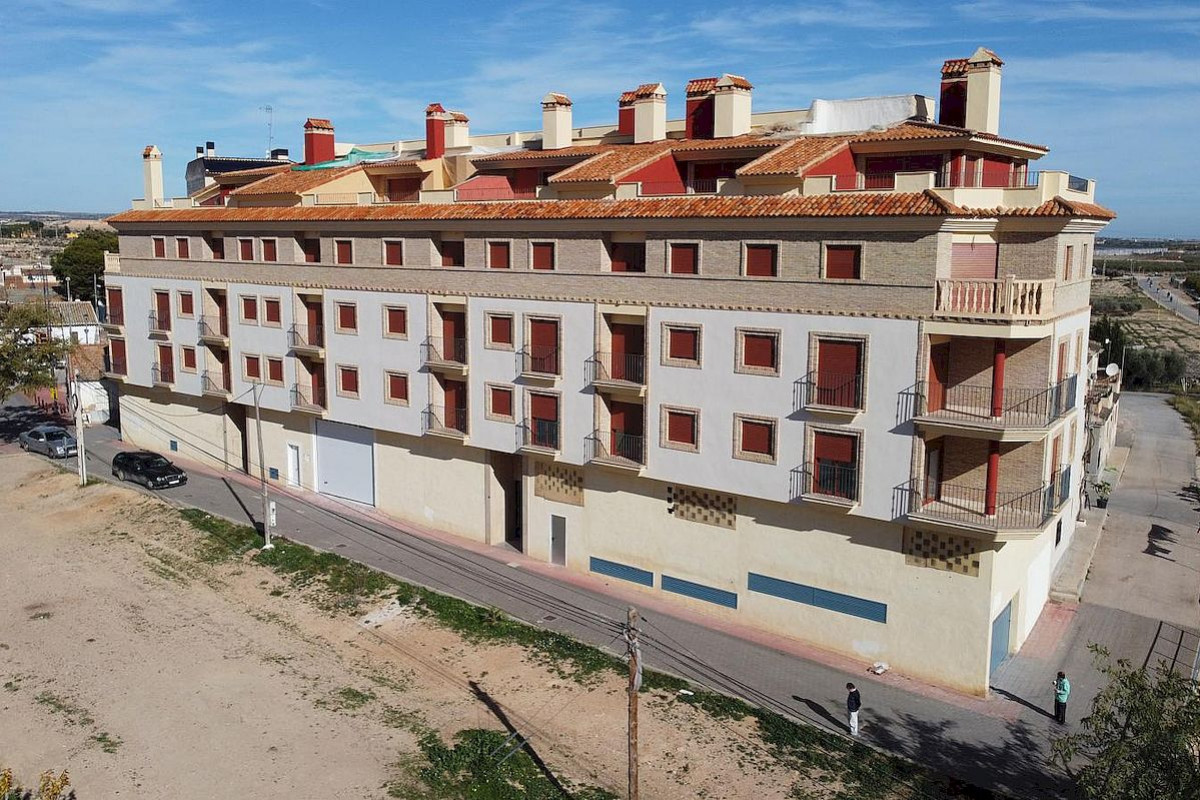
- WES-2429 – Murcia 1-bed, 45 m², €78,000: entry-level urban, strong raw yield near 7.5% at asking price
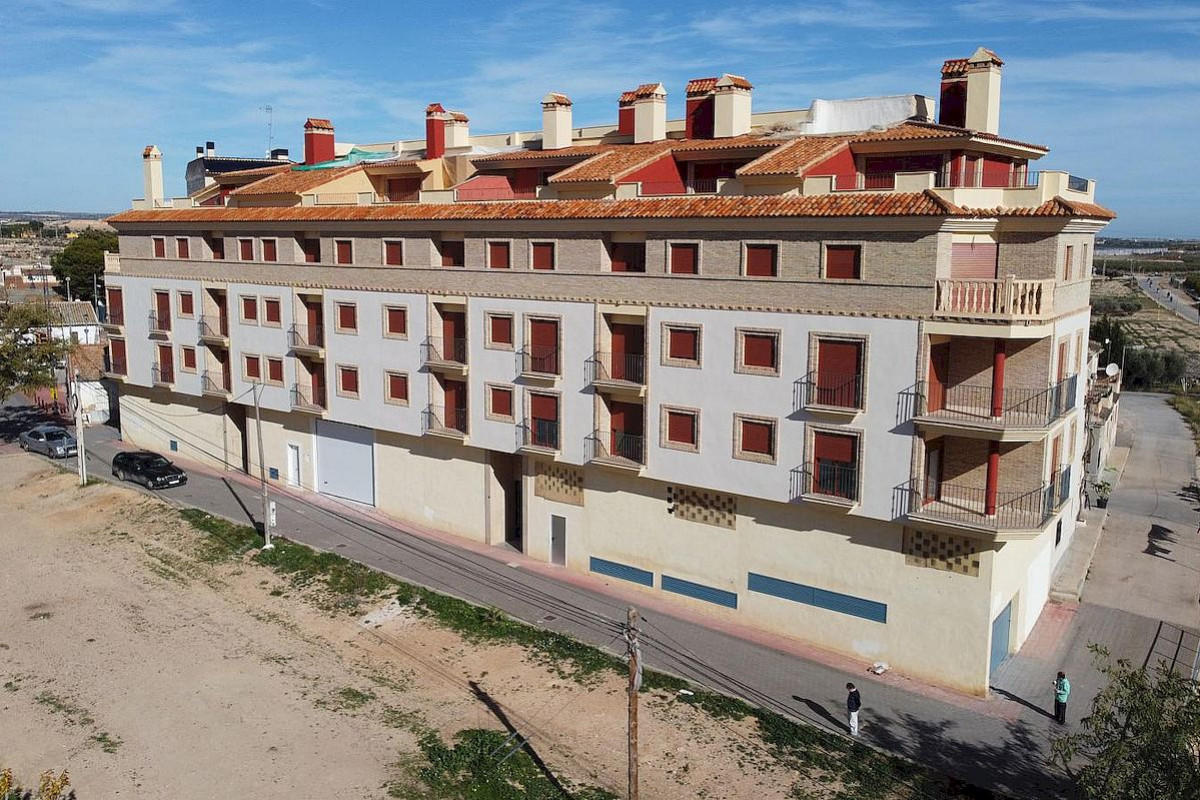
- WES-2402B – San Miguel de Salinas 1-bed, 53 m², €150,000
- WES-2240 – Lomas de Cabo Roig 1-bed, 52 m², €147,500
Tier 2: 5.0% to 6.0% (balanced)
Los Alcazares, Pilar de la Horadada, Orihuela Costa, Guardamar. Prices in the €200,000 to €280,000 range, tenant demand strong but slightly slower turnover. Best fit for buyers who want gross yield above 5% without the smallest urban-apartment format.
Tier 3: below 5% (capital-focus)
Benidorm, Villajoyosa, Denia, Calpe. Entry prices above €260,000. Yields lower because asking prices reflect coastal-premium capital-appreciation expectations rather than rental math. Best fit for buyers prioritising long-hold capital growth over cash-on-cash return.
Browse each town: Torrevieja (115 listings), San Pedro del Pinatar (42), Los Alcazares (64), Orihuela Costa (36), Pilar de la Horadada (61), Denia (22), Calpe (8).
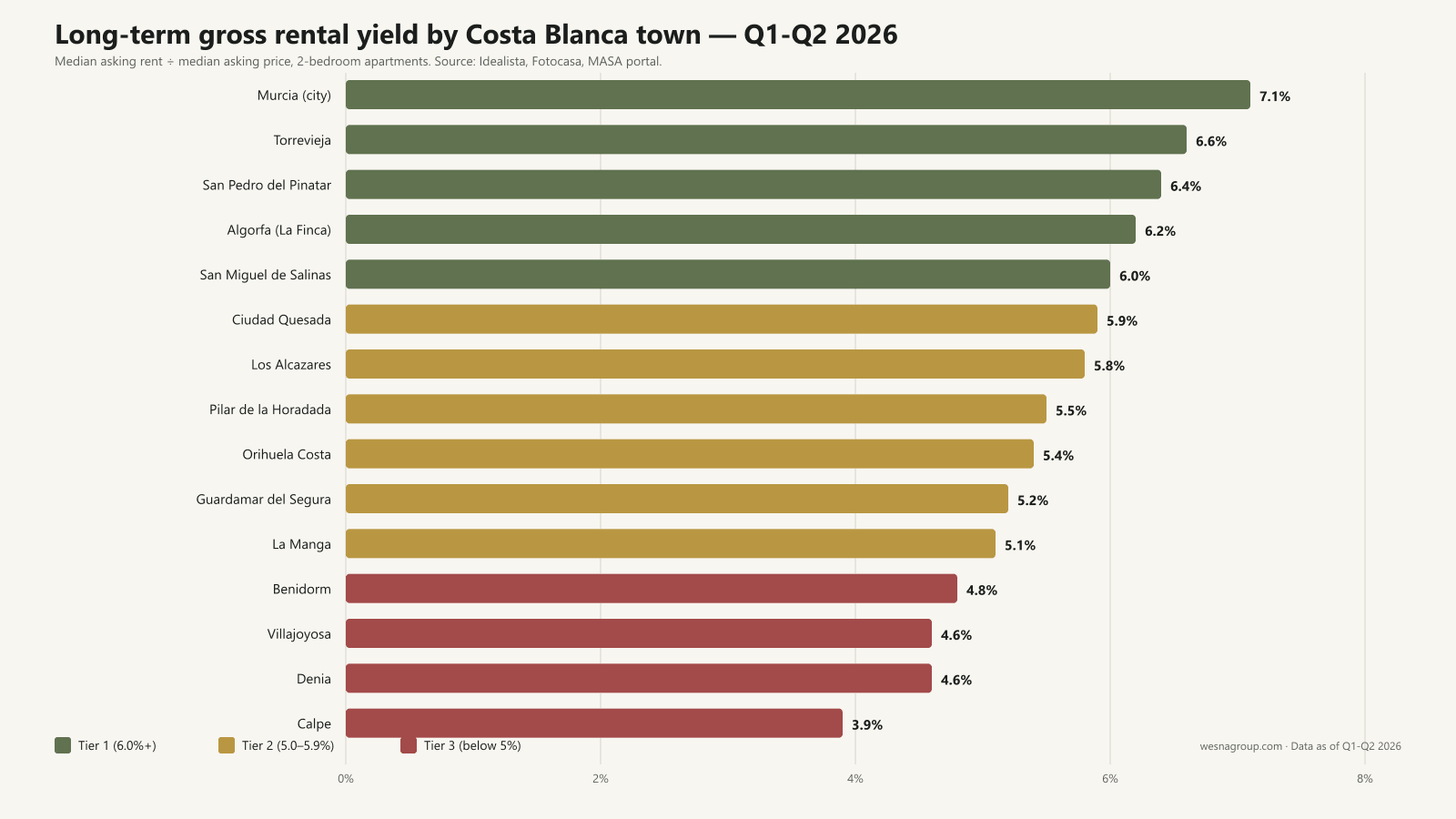
Chart: gross long-term yield by town, tier-colour-coded (Q1-Q2 2026 aggregated data).
Chart: gross long-term yield by town, tier-colour-coded (Q1-Q2 2026 aggregated data).
Chart: gross long-term yield by town, tier-colour-coded (Q1-Q2 2026 aggregated data).
Which apartment size delivers?
Across the Costa Blanca in Q1-Q2 2026, the median gross yield by apartment size:
| Size | Median gross yield |
|---|---|
| 1-bed | 5.8% |
| 2-bed | 5.4% |
| 3-bed | 4.9% |
| Detached house | 4.2% |
The 1-bed segment leads because entry prices are lowest relative to rental prices per m². Short-term expats and single workers pay disproportionately more per m² than family tenants in 3-bedroom properties.
Vacancy patterns
Long-term rental vacancy for 2-bed apartments in Q1-Q2 2026:
- Torrevieja, San Pedro del Pinatar, San Miguel de Salinas: under 3 weeks per year on turnover. Retiree demand is stable.
- Orihuela Costa, Los Alcazares, Pilar de la Horadada: 4 to 6 weeks per year. Mix of tourist and long-term shifts the vacancy pattern seasonally.
- Benidorm, Villajoyosa, Denia, Calpe: 6 to 10 weeks per year. Tourist-market pressure creates soft season gaps.
Regulatory and tax context for 2026
Three things buyers should factor into net-yield math:
- IRNR (Modelo 210): 19% on rental income for EU residents, 24% for non-EU. Deductible expenses (community fees, mortgage interest, IBI, maintenance) reduce the taxable base for EU residents but not for non-EU.
- Valencia STR ban aftershock: for towns in Alicante province, new tourist licences are paused. Existing licences transfer with the property; new ones case-by-case. Factor this into your acquisition strategy.
- Long-term contracts (LAU 5/7 years): post-2019 tenancy law protects tenants with 5-year (private landlord) or 7-year (corporate landlord) automatic extensions. Rent can be adjusted annually but only within IPC (inflation index) limits.
For the full non-resident purchase process, see our 12-step buying checklist.
Recommendations by buyer profile
Yield-first buyer, €80k to €150k budget: 1-bed apartment in Torrevieja, Murcia city, or San Miguel de Salinas. Expected gross yield 6.0% to 7.5%. Small management footprint, retiree or expat tenant, low turnover.
Balanced buyer, €150k to €250k budget: 2-bed in Torrevieja, Los Alcazares, San Pedro del Pinatar, or Pilar de la Horadada. Expected gross yield 5.5% to 6.5%. Better retention, mid-tier tenants, small step-up in maintenance.
Capital-first buyer, €250k+ budget: 2-bed or 3-bed in Denia, Calpe, Villajoyosa, Benidorm front-line areas. Expected gross yield 3.5% to 4.8%. Long-hold capital appreciation drives the return, rent covers holding costs plus modest cash flow.
FAQ
What net yield should I expect after taxes and costs? Rule of thumb: net yield equals 65% to 75% of gross yield for standard non-mortgaged properties. A 6% gross typically translates to 4.0% to 4.5% net. With a 60% LTV mortgage at 4%, cash-on-cash return on equity can be significantly higher, but so is the risk if occupancy drops.
How does the Valencia STR ban affect long-term yields? Positive. Supply of long-term rental stock in Alicante province rose 12% year-on-year in Q1 2026 as former short-term listings converted, but tenant demand rose faster. Net effect: rental rates rose 4% to 7% in most towns, and long-term contracts became easier to secure.
Are these gross yields sustainable in 2027? The Bank of Spain's Q1 2026 financial-stability report notes long-term rental demand outstrips supply nationally. Nothing structural suggests yield compression in 2026-2027 for the Costa Blanca. Watch: new-build supply in Ciudad Quesada, Los Alcazares and Pilar de la Horadada is elevated and may soften those specific yield points by 20 to 40 bps in 2027.
Should I self-manage or use a property manager? Property manager costs 8% to 12% of rent monthly. Below €900/mo rent, self-management typically pencils better. Above €1,200/mo rent and with a mortgage, professional management often protects yield better than cost.
How reliable is Idealista rental data? Idealista publishes an asking-rent index monthly; realised rent typically lands 4% to 8% below asking. Fotocasa figures are similar. For institutional-grade data, Bank of Spain (Banco de España) publishes a quarterly rental price index sourced from AEAT tax filings.
Contact us
For property-specific yield analysis, contact Wesna. We provide town-level rental comparables, historical price appreciation data, and a full purchase + rental setup for buy-to-let investors, including tenant screening and management coordination in English, Russian, Ukrainian and Spanish.
Related reading: Buying property as a non-resident in 2026, Buy-to-Let Costa Blanca 2026, Valencia STR ban alternatives.
Get our Costa Blanca property guides
One short email a month with new neighborhood guides, market notes, and rule changes. No spam, unsubscribe in one click.
We use your email only for the newsletter. Read our privacy policy for details.