
Brexit 90/180 Rule in Spain 2026: British Owners' Guide
 Wesna Group
Ninety days in any rolling 180 is a British passport holder's full allowance in Spain, and owning property adds nothing to it. A worked example with real dates, what the EES biometric system changed at the border, and the visa routes that buy more time.
Ninety days in any rolling 180. That is the entire entitlement a British passport carries in Spain since 1 January 2021, and buying a flat in Torrevieja adds nothing to it. Owners get caught every summer because they read the rule as two calendar halves. It is not calendar halves, and the difference can be six weeks of holiday either way.
The rule, stated correctly
The Schengen Borders Code (Regulation (EU) 2016/399, Article 6) allows a visa-exempt third-country national up to 90 days of presence in any 180-day period. Since the end of the transition period, a UK passport holder is a third-country national. Three details in that sentence cause almost every miscalculation.
The window rolls. On any day you are physically in Spain, count back 179 days from that date, add the day itself, and total your days of presence inside that 180-day block. Over 90 and you are illegally present, even though you entered legally and nobody stopped you. There is no 1 January reset and no "first half, second half".
The area is not Spain. All 29 Schengen states draw on the same allowance. A fortnight in Portugal or four days driving through France comes straight off the days you can spend at your own property. Ireland and Cyprus sit outside Schengen and do not count against you.
Part days are whole days. Land at Alicante at 23:40 and fly home at 06:00 nine days later, and you have used ten days. Both the arrival and departure dates count in full.
A worked example with dates
Take an owner in Ciudad Quesada planning three trips in 2026.
| Trip | Dates | Days used | Total inside the 180-day window on the last day of the trip |
|---|---|---|---|
| Winter | 10 January to 20 February 2026 | 42 | 42 |
| Spring | 15 April to 14 May 2026 | 30 | 72 |
| Summer | 1 July to 29 August 2026 | 60 | 90 |
On 1 July the window reaches back to 3 January, so both earlier trips sit inside it and simple subtraction says 18 days remain. Most owners stop there and book a fortnight. From 9 July onwards, though, the January days start dropping off the back of the window at the same rate new days are added, so the balance freezes at 80 for six weeks. By 19 August the whole winter trip has aged out. The count then climbs by one a day and touches exactly 90 on 29 August. Stay until 30 August and the window holds 91 days, and you are an overstayer.
That owner spent 132 days in Spain during one calendar year without ever breaching the rule. Arriving on 1 July and leaving after the assumed 18 days would have wasted six legal weeks. Run your own dates through the European Commission's short-stay calculator before you book anything, and keep the output.
Owning the property gives you no extra days
An escritura is a title deed, not an immigration document. Neither an NIE, a Spanish bank account, nor a decade of paid IBI receipts move the border officer at Alicante-Elche one day in your favour. Forum posts about pre-Schengen bilateral agreements circulate every spring; none of them gives a British owner longer in Spain.
What has changed is the enforcement. The EU Entry/Exit System began its phased rollout at external borders on 12 October 2025 and reached every crossing point in April 2026. It replaced the wet passport stamp with a biometric record: facial image, four fingerprints, and a timed entry and exit for every crossing, held centrally and readable by every Schengen state. Your remaining days are calculated automatically at the booth. The old defence of an unstamped passport, or a stamp the officer could not read, has stopped working. ETIAS, the online authorisation British travellers will also need, is due to follow at the end of 2026; it buys permission to travel, not extra days.
Overstaying is treated in Spain as a serious infringement under Ley Orgánica 4/2000, carrying a fine of EUR 501 to EUR 10,000 and, in worse cases, an expulsion order with a re-entry ban across the whole Schengen area. In practice the first consequence most people meet is refusal of entry on the next trip, at which point they own a house they cannot visit. A weekend in Tangier does not reset anything.
Where British owners buy, and how they use the ninety days
Britons remain the largest single foreign nationality in the Spanish market. Registradores de España puts purchases by non-Spaniards at roughly 15% of all transactions nationally, with the British share of that foreign block at approximately 8%, in the region of 7,000 to 8,000 homes a year. In Alicante province foreign buyers take something over 40% of all purchases.
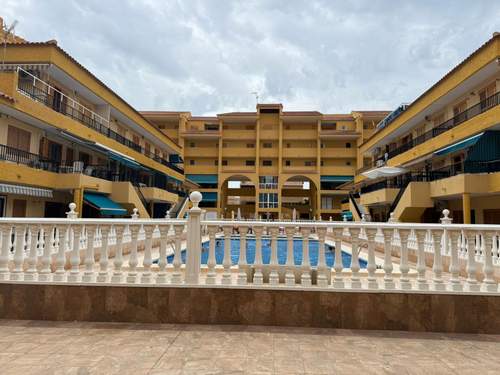
The clusters have barely moved in twenty years. Orihuela Costa, Torrevieja and the inland urbanisations at Ciudad Quesada and San Miguel de Salinas hold the largest British populations on the Costa Blanca South, with Los Alcázares and Pilar de la Horadada picking up the Mar Menor end. North of Alicante, La Nucía and Villajoyosa draw buyers who want hills and a Spanish town centre rather than a coastal urbanisation, and Benidorm's Sierra Cortina slope pulls year-round owners who want a lift, a lock-up-and-leave and an airport 45 minutes away.
Budget shapes the pattern more than nationality does. Our live sale stock starts at a EUR 82,000 apartment and runs to a EUR 459,000 median for houses, so an owner might weigh WES-1410, a 1-bed 77 m2 Benidorm apartment at Cala Finestrat, EUR 275,000 against something larger and cheaper further south. The Torrevieja sale list is the deepest we hold, at 126 homes.
Two long stays work better under a rolling window than five short breaks. Each trip bills a full day for the flight out and a full day for the flight home, whatever the hours flown, so five long weekends spend ten of your ninety days on airports. Check your own family before you check the visa routes. If a spouse holds an Irish passport, the British partner can apply for a tarjeta de familiar de ciudadano de la Unión, which removes the limit entirely, provided the Irish spouse registers as a resident here too.
Routes past ninety days, and the tax bill attached to them
The Golden Visa is gone. The investor residence route was repealed by Ley Orgánica 1/2025 and closed to new applications on 3 April 2025, so a EUR 500,000 purchase buys no residence rights in 2026. The alternatives that actually exist are ordinary residence permits with ordinary conditions.
| Non-Lucrative Visa | Digital Nomad Visa | |
|---|---|---|
| Income test | Passive income of roughly EUR 29,000 for one applicant, plus about EUR 7,200 per dependant, indexed to IPREM | Roughly EUR 33,000 a year, 200% of the SMI, recalculated when the minimum wage changes |
| Work | None permitted, including remote work for a UK employer | Remote work for non-Spanish employers or clients, Spanish-sourced income capped at 20% |
| Health cover | Full private policy with a Spanish-authorised insurer, no co-payments, no waiting periods | Private policy or Spanish social security registration |
| Duration | One year, then renewals of two plus two | One year via consulate, three years if applied for inside Spain |
| Tax angle | Standard resident taxation | May elect the Beckham regime, 24% flat on employment income to EUR 600,000 |
Full detail sits in our walkthroughs of the Non-Lucrative Visa and the Digital Nomad Visa.
Both routes carry a consequence the brochures skip. Under Article 9 of the Spanish personal income tax law you become tax resident once you spend more than 183 days of a calendar year in Spain, and NLV renewal effectively requires exactly that. Tax residency pulls your worldwide income into Spanish scope: UK rental profits, dividends, most private and state pensions. UK government service pensions stay taxable only in the UK under the 2013 double tax treaty, though Spain still counts them when setting your rate. Add the Modelo 720 declaration of foreign assets above EUR 50,000 per category, and the Valencian Community's wealth tax on net assets above EUR 500,000. For a couple with UK investments, the annual tax cost of residency can comfortably exceed a villa rental for the extra two months.
What you still owe while staying under ninety days
Under 90 days you are a non-resident owner, and non-resident owners still file and still pay. Spain charges an imputed income tax on any home not let out, calculated at 1.1% of the cadastral value where that value has been revised in the last ten years, or 2% where it has not. Since Brexit the rate applied to British owners is 24% rather than the 19% left to EU and EEA residents. On a cadastral value of EUR 90,000 with a recent revision, that is roughly EUR 238 a year, declared on Modelo 210 by 31 December of the following year. If you do let the property, the same Brexit change bites harder: UK-resident landlords pay 24% on gross rent with no deduction for community fees, mortgage interest or repairs, now grouped into one annual return filed in the first 20 days of January.
IBI is the other standing bill. Your ayuntamiento sets it as a percentage of that same cadastral value, and a typical coastal apartment runs roughly EUR 200 to EUR 600 a year, visited or not. The rubbish charge, community fees and non-resident bank charges run on as well, best handled as direct debits from a Spanish account. Our guide to annual property taxes for non-residents lists the full set with typical amounts.
The practical gap is supervision. Many Spanish home insurers restrict cover once a property has been unoccupied for 30 or 60 consecutive days, which is exactly the situation a 90/180 owner creates, so check your policy before you leave. Someone local needs keys and the authority to let a plumber in.
Frequently asked questions
Does owning a Spanish property give me any extra days?
No. Ownership, an NIE and a Spanish bank account carry no immigration rights at all. The only ways to exceed 90 days in 180 are a residence permit, a national long-stay visa, or a family member card through an EU-citizen spouse.
Does a week in France count against my Spanish 90 days?
Yes. The allowance covers all 29 Schengen states together, so days in France, Portugal, Italy or Norway reduce what is left for Spain. Time in Ireland, Cyprus or the UK does not count.
Do arrival and departure days both count?
Both count as full days, regardless of flight times. A trip landing on 3 May and departing on 12 May uses ten days, not nine. That alone causes a lot of accidental overstays across a year of short breaks.
What actually happens if I overstay by a week?
Under Ley Orgánica 4/2000 an irregular stay is a serious infringement, with fines from EUR 501 to EUR 10,000, and the Entry/Exit System records the dates automatically. The more common outcome is refusal of entry on your next arrival, with the record visible to every Schengen border post.
Will a Non-Lucrative Visa make me a Spanish tax resident?
In practice, yes. Renewal expects genuine residence in Spain, and passing 183 days in a calendar year makes you tax resident on worldwide income. Model the tax before you apply, not after the consulate stamps the visa.
Next steps
Before you book next year's flights, plot every planned trip on a rolling 180-day count and see where the ceiling really falls. If the answer pushes you toward a permit, read Spain residency 2026: visa paths first.
Get our Costa Blanca property guides
One short email a month with new neighborhood guides, market notes, and rule changes. No spam, unsubscribe in one click.
We use your email only for the newsletter. Read our privacy policy for details.